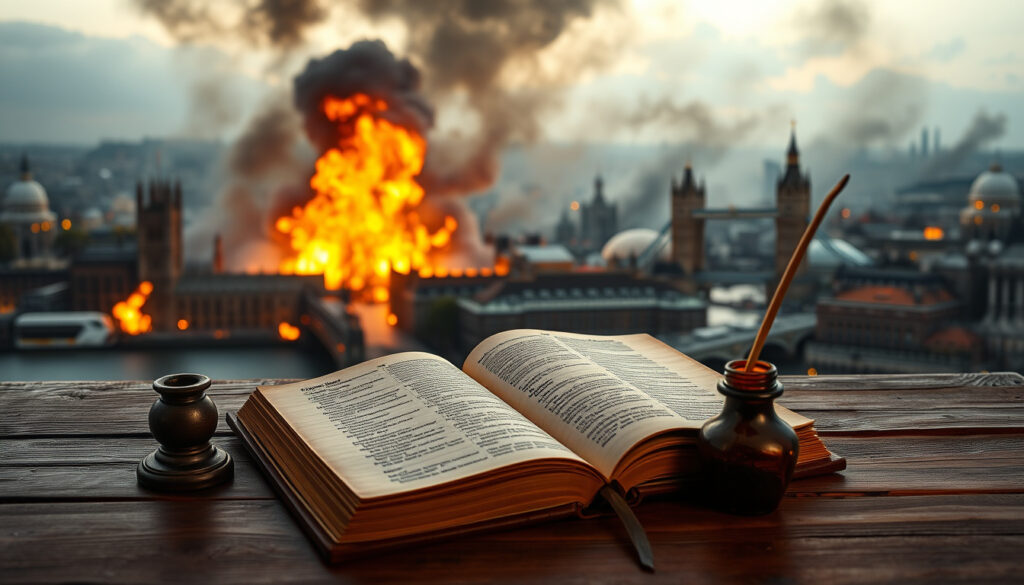
Samuel Pepys: The Diarist Who Saw the Great Fire
Few diaries open a window onto history quite like Samuel Pepys’s, written between 1660 and 1669 from his desk at the Navy Board; his account of the Great Plague of 1665 and the Great Fire of London the following year remains one of the most vivid primary sources of the Restoration period. The man behind the ink was a naval administrator, a Member of Parliament, and a remarkably candid chronicler of both public catastrophe and private indiscretion.
Quick snapshot
Confirmed facts
- Pepys wrote the diary from 1660 to 1669.
- He was an eyewitness to the Great Fire of London.
- The diary contains about 1.25 million words.
What’s unclear
- Why Pepys stopped writing his diary in 1669.
- The exact nature of his final illness.
Timeline signal
- 1633: Born in London, son of a tailor.
- 1660: Begins diary; becomes Clerk of the Acts to the Navy Board.
- 1665: Stays in London during the Great Plague and records the epidemic.
- 1666: Witnesses the Great Fire of London, documents its progress and aftermath.
- 1669: Stops writing diary.
What’s next
- Birth date: 23 February 1633
- Death date: 26 May 1703
- Occupation: Naval administrator, Diarist, Member of Parliament
- Known for: Diary covering 1660–1669
Together these facts frame the man behind the diary.
What is Samuel Pepys most famous for?
Pepys’s diary is one of the most important primary sources for the English Restoration period.
- He was an eyewitness to the Great Fire of London (Royal Museums Greenwich).
- The diary contains about 1.25 million words (Open Library).
Coverage of the Great Fire and Great Plague
- His diary records daily life during the Great Plague of 1665.
- He witnessed the Great Fire of London in 1666 and documented its progress and aftermath.
Eyewitness account: Pepys’s description of the fire is among the most frequently quoted passages in his diary.
Together, these details explain why the diary is one of the most vivid primary sources for the English Restoration period.
Did Samuel Pepys love his wife?
Readers see a man who cherished his wife yet could not resist temptation.
His diary is famously candid about his own failings, including his infidelities and his complicated feelings about Elizabeth Pepys.
Readers see a man who cherished his wife yet could not resist temptation.
Was Samuel Pepys unfaithful?
- His diary is a window into the double standards of Restoration society (EBSCO Research).
- Pepys recorded both his desire for reform and his inability to change (Encyclopaedia Britannica).
This honesty makes the diary a uniquely valuable document for understanding private life in the 1660s.
Was Samuel Pepys imprisoned?
The pattern: Pepys’s imprisonment was a political hit job, not a reflection of actual guilt.
His imprisonment was a political hit job, not a reflection of actual guilt.
How do you pronounce Pepys?
The catch: getting the pronunciation wrong is a quick giveaway, but Pepys himself likely used the “peeps” sound.
The upshot for readers: Whether you say “peeps” or “Pep-iss,” the man behind the name left a diary that continues to shape how we see Restoration England. The pronunciation trivia is a reminder that language changes—but his words remain fixed in ink.
Language changes, but his words remain fixed in ink.
What we know and what remains unclear
Samuel Pepys, diary entry, 23 February 1660/61.
- 1633: Born in London, son of a tailor.
- 1660: Begins diary; becomes Clerk of the Acts to the Navy Board.
- 1665: Stays in London during the Great Plague and records the epidemic.
- 1666: Witnesses the Great Fire of London, documents its progress and aftermath.
- 1669: Stops writing diary.
Pepys died on 26 May 1703 in Clapham, likely from complications of old age. He and Elizabeth Pepys had no surviving children. His family line died out.
Samuel Pepys left behind roughly 1.25 million words, and the diary remains the most vivid bridge between the 21st century and the 1660s.
What was Samuel Pepys’s role in the Navy?
He served as Clerk of the Acts to the Navy Board and later as Secretary to the Admiralty, reforming naval administration and supply (Royal Museums Greenwich).
It was a role that gave him a front-row seat to the events he recorded.
Related reading: Stephen Fry: Biography, IQ, Conviction & Personal Life · Terry Pratchett: Biography, Books, and Lasting Legacy
bbc.com, bbc.co.uk, en.wikipedia.org, britannica.com, npg.org.uk, londonmuseum.org.uk, smithsonianmag.com, britannica.com, rmg.co.uk, rmg.co.uk, pepysdiary.com, ebsco.com
More related posts
 Camper Vans for Sale – 2025 Prices, Models & Guide
 Final Fantasy 7 Remake: Differences, Part 3, and FAQs (2025)
 Rachel Bilson: Biography, Net Worth, Kids, Co-Parenting
 Jack McMullen Movies and TV Shows: Full Filmography
 Brian Murphy: Biography of George and Mildred Star
 Tom Ackerley: Producer, Barbie & LuckyChap Co-Founder
 South Africa National Cricket Team: History, Stats & News
 Hailee Steinfeld: True Grit Star’s Life and Career