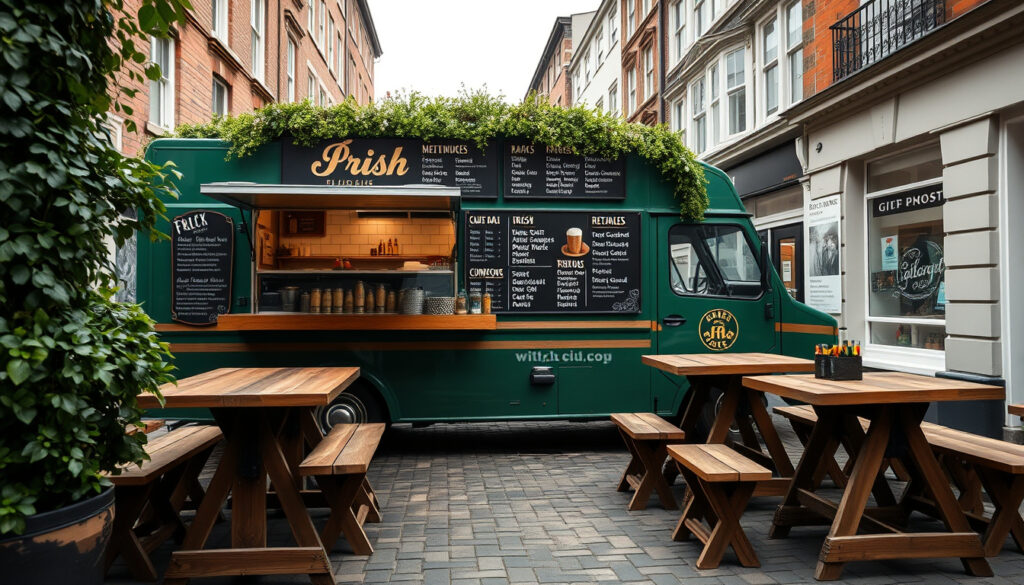
Food Truck Ireland: Licensing, Costs & Profitability
If you’ve ever watched a queue form at a market day food truck and wondered if you could do it yourself, you’re not alone. The Irish food truck scene is buzzing right now, with 134 trucks listed for sale on DoneDeal alone and 19 suppliers on WeddingsOnline.ie.
Food truck ads on DoneDeal: 134 · Food truck suppliers on WeddingsOnline.ie: 19 · Food truck builder location: Co. Meath, Ireland
Quick snapshot
- Food trucks must be registered with the HSE before trading (Health Service Executive (HSE), Ireland’s food safety regulator)
- A licence from the local council is mandatory (Food Safety Authority of Ireland (FSAI) guidance)
- 134 food truck ads exist on DoneDeal (Health Service Executive (HSE), Ireland’s food safety regulator)
- Average food truck profit margin in Ireland is not officially documented
- Exact startup cost ranges vary widely by location and truck type
- The true failure rate for Irish food trucks is unknown
- No recent changes to HSE registration or FSAI rules for mobile food businesses (FSAI guidance remains current)
- Local councils continue to process licences on an individual basis (FSAI guidance remains current)
- New entrants should budget for HSE registration and council licence upfront
- Watch for local authority updates on street trading permits
- Consider seasonal demand and event bookings for revenue stability
The key numbers behind the Irish food truck market, drawn from classifieds and official sources, show a sector with real momentum.
| Fact | Value |
|---|---|
| Food truck ads on DoneDeal | 134 |
| Food truck suppliers on WeddingsOnline.ie | 19 |
| Food truck builder (custom) location | Co. Meath, Ireland |
| HSE registration required before trading | Yes, mandatory under EU regulation (HSE) |
| Typical licence fee | €63/month or €380/year (Square Ireland, payment and business guide platform) |
| Basic food trailer start price | From €5,000 (Dairyglen, ice cream and catering equipment supplier) |
| Food truck rental (monthly) | €2,000 – €3,000 (Square Ireland) |
| Irish food service industry value | €9.2 billion (Swoop IE, business funding advisory) |
Do you need a licence for a food truck in Ireland?
What type of licence is required?
- Food businesses, including food trucks, must be registered with the Health Service Executive (HSE) before starting to trade, under Article 6(2) of Regulation (EC) No. 852/2004 (HSE, Ireland’s public health executive).
- The Food Safety Authority of Ireland (FSAI) confirms that a food truck must follow the same steps as any food business: registration, a food safety management system, and compliance with traceability rules (FSAI, statutory agency).
- Additionally, traders need a licence to trade from the local authority where they operate. The Local Enterprise Office Offaly emphasises that a trader must assess whether they will get a licence for their chosen site (Local Enterprise Office Offaly, enterprise support body).
How to apply for a food truck licence in Ireland
The process involves three main steps:
- Register with the HSE — notify the HSE of your food business at least 28 days before opening. Use the online form on about.hse.ie.
- Secure a site and get council permission — approach the local authority’s trading standards or licensing department. Licence fees vary: Square Ireland reports €63 per month or €380 per year as a typical range (Square Ireland).
- Prepare food safety documents — the FSAI requires a Hazard Analysis and Critical Control Point (HACCP) plan and allergen management procedures (FSAI).
The pattern: licensing in Ireland is not a single national permit but a three-layer stack of HSE registration, local council permission, and food safety compliance — and all three apply before you serve your first customer.
Without HSE registration and a local council licence, you are operating illegally. The HSE can shut down unregistered operations and fines apply.
How much does it cost to start a food truck in Ireland?
Cost of the truck itself
You have two main options: buy used or go custom. Used food trucks appear regularly on DoneDeal (134 ads at the time of writing), with prices ranging from a few thousand for a basic trailer to €30,000+ for a fully fitted van. Custom builds from specialists like Retro Food Trucks in Co. Meath start higher but include tailored layouts. Dairyglen quotes a basic food trailer from €5,000 (Dairyglen, catering equipment specialist).
Equipment and fit-out costs
- Catering equipment (griddle, fryer, extraction, fridge): can easily run €3,000–€8,000.
- Gas and electrical installations: €1,000–€2,000 depending on complexity.
- Branding, signage, and POS system: €500–€2,000.
- Initial food inventory: Square Ireland estimates about 30% of your initial spend (Square Ireland).
Permits and insurance costs
Licence fees range from €63/month to €380/year, according to both Square Ireland and Caterboss (Caterboss, catering industry guide). Public liability insurance for a food truck typically costs €500–€1,200 per year, depending on cover level and trading locations. Some councils also require a street trading permit, which adds another layer of cost.
Total startup costs for a food truck in Ireland can range from roughly €10,000 (used basic trailer with minimal equipment) to €50,000+ (custom build with full fit-out). The single biggest variable is the vehicle itself.
What this means: the upfront investment is comparable to a small restaurant, but the ongoing overhead — rent for a pitch, fuel, and insurance — is lower. However, that lower overhead comes with weather risk and limited trading days.
How much do food trucks make in Ireland?
Average daily or weekly revenue
Reliable revenue data is scarce. A Streat School TikTok clip claimed Irish food-truck annual turnover can range from €120,000 to €600,000 (Jackery EU, portable power brand — citing social media source, low confidence). That wide range reflects the reality: a truck at a busy festival or city lunch spot can do serious numbers, while a rural pitch might struggle to cover costs. A Reddit summary of an Irish Times article noted that festival operators can sometimes only break even (Reddit / Irish Times referenced summary, low confidence).
Factors affecting income
- Location: footfall is everything. A pitch near offices at lunchtime outperforms a rural market.
- Menu pricing: high-margin items like coffee and loaded fries can boost profitability.
- Seasonality: Irish weather drives summer peaks and winter troughs.
- Event bookings: festivals and fairs offer concentrated revenue but come with booking fees and competition.
The trade-off: potential revenue is there — the industry is worth €9.2 billion — but without official Irish food truck profit data, you’re relying on anecdotal ranges and your ability to negotiate the right pitch.
What are the most profitable and popular foods for a food truck?
Top selling items from existing Irish food trucks
Scanning supplier listings and market offerings, three categories dominate:
- Wood-fired pizza — low ingredient cost, high perceived value, quick cook time.
- Burgers and gourmet sandwiches — classic crowd-pleasers with flexible pricing.
- Gourmet fries (loaded fries, poutine) — cheap base ingredient, high markup.
These are not officially ranked but appear consistently on supplier menus across WeddingsOnline.ie and DoneDeal listings.
Profit margins on different menu items
Jackery EU reports typical net profit margins for food trucks range from 7% to 15% (Jackery EU, low confidence — sourced from generic industry data, not Ireland-specific). Coffee and drinks can push margins above 70%, while proteins and premium ingredients eat into profits. The most profitable trucks focus on a tight menu with high throughput.
Why this matters: menu design is your biggest profit lever. A pizza truck with a €12 average ticket can clear €1,200 on a good day with two staff. A burger truck with the same ticket price may need higher volume to match that margin due to longer cook times.
Is a food truck a good business in Ireland?
Upsides
- Lower startup and overhead costs compared to a brick-and-mortar restaurant
- Flexibility to change location based on demand and events
- Direct customer interaction builds loyalty and immediate feedback
- Growing market — 19 food truck suppliers on WeddingsOnline.ie indicate robust demand
Downsides
- Weather-dependent: revenue drops significantly during Irish rain and winter
- Regulatory hurdles: multiple licences and HSE registration required before trading
- Limited trading windows: peak hours (lunch, events) compress earning time
- Profitability can be razor-thin: some operators only break even at festivals (Reddit / Irish Times summary)
The verdict: food trucks make sense if you’re comfortable with seasonal cash flow, have a tight menu with high margins, and can secure a high-footfall location. For risk-averse operators, a weekend-only model or a catering-only approach may be safer.
Step-by-Step Guide to Starting a Food Truck in Ireland
- Research your local council’s trading licence rules — contact the local authority where you plan to trade.
- Register with the HSE — use their online notification form at least 28 days before opening.
- Choose your truck — browse DoneDeal for used options or contact Retro Food Trucks (Co. Meath) for a custom build.
- Fit out the vehicle — source catering equipment, arrange gas/electrical work, and install a point-of-sale system.
- Arrange insurance — public liability (€500–€1,200/year) and vehicle insurance.
- Develop a HACCP plan and menu — the FSAI requires food safety documentation (FSAI guidance).
- Source initial stock — allocate about 30% of your startup budget to inventory (Square Ireland).
- Secure a pitch or event bookings — check local markets, festivals, and private land permissions.
- Launch and market — use social media to broadcast your location daily.
Confirmed facts
- HSE registration is mandatory for all food businesses before trading (HSE)
- Local council licence needed for each trading site (Local Enterprise Office Offaly)
- 134 food trucks listed on DoneDeal and 19 suppliers on WeddingsOnline.ie confirm active market
- Licence fee range: €63/month to €380/year (Square Ireland)
- Food service industry in Ireland valued at €9.2 billion (Swoop IE)
What’s unclear
- Exact profit margins for food trucks in Ireland — no official survey exists
- Average startup cost — varies too widely by truck type and location to pin a single number
- Failure rate — no Irish data tracks how many food trucks close within a year
“Custom building a food truck allows you to design the workflow, but the biggest challenge is finding a pitch that delivers enough footfall to cover the investment.”
— Retro Food Trucks Ireland, custom food truck builder based in Co. Meath
“The 19 food truck suppliers listed on our platform show that there’s a healthy ecosystem of caterers and builders ready to serve the growing mobile food market in Ireland.”
— WeddingsOnline.ie, Irish wedding and event supplier directory
Starting a food truck in Ireland is a viable small-business opportunity — if you treat the regulatory steps as non-negotiable and design a menu that works in Irish weather and event cycles. The implication for aspiring owners: secure your licence and choose a high-footfall location, or risk operating in a grey area where costs outrun revenue.
Frequently asked questions
What permits are needed besides a licence?
You’ll need HSE food business registration, a local council street trading permit (in many areas), and public liability insurance. Some councils also require a hygiene inspection before they grant a licence.
Can I operate a food truck anywhere in Ireland?
No. You must trade on land where you have permission from the landowner, and that land must have a licence for trading from the local authority. Public land usually requires a street trading permit. Private property (e.g., a supermarket car park) needs both the owner’s consent and council approval.
How long does it take to get a licence?
HSE registration can be done online but you must notify them at least 28 days before opening. Council street trading permits can take two to six weeks, depending on the local authority and whether a site inspection is required.
What insurance is required for a food truck?
At minimum: public liability insurance (typically €500–€1,200/year) and vehicle insurance (if the truck is motorised). Some event organisers also require employer’s liability insurance if you hire staff. Check with your local authority for any additional cover they mandate.
Do I need a food hygiene certificate?
Yes. The FSAI requires that all food handlers have appropriate training, usually a Level 2 food hygiene certificate (e.g., from the Royal Environmental Health Institute of Ireland or similar). The truck itself must also pass a food safety inspection within its first year of operation.
Can I sell alcohol from a food truck?
Generally no, unless you apply for a special occasional licence for a specific event from the local District Court. Permanent alcohol sales from a mobile unit are not permitted under the Licensing Acts. Check with your local council for exceptions.
More related posts
 Ruby Franke Case: Latest Verified Facts, Sentence, Documentary
 How Much Is Spotify Premium? (2025 Prices & Plans)
 Clint Eastwood 2025: Age, Net Worth, Family & Politics
 Guy Fieri: Tragedy, Health Scare, and Food Network Fame
 Tom Aspinall Next Fight: Opponent, Date, and Injury Update (2026)
 30 Days From Today – Exact Date and Step-by-Step Guide
 Michelle Randolph: Age, Relationships, Landman Role & More
 American Akita: Temperament, Ownership, and Key Breed Differences