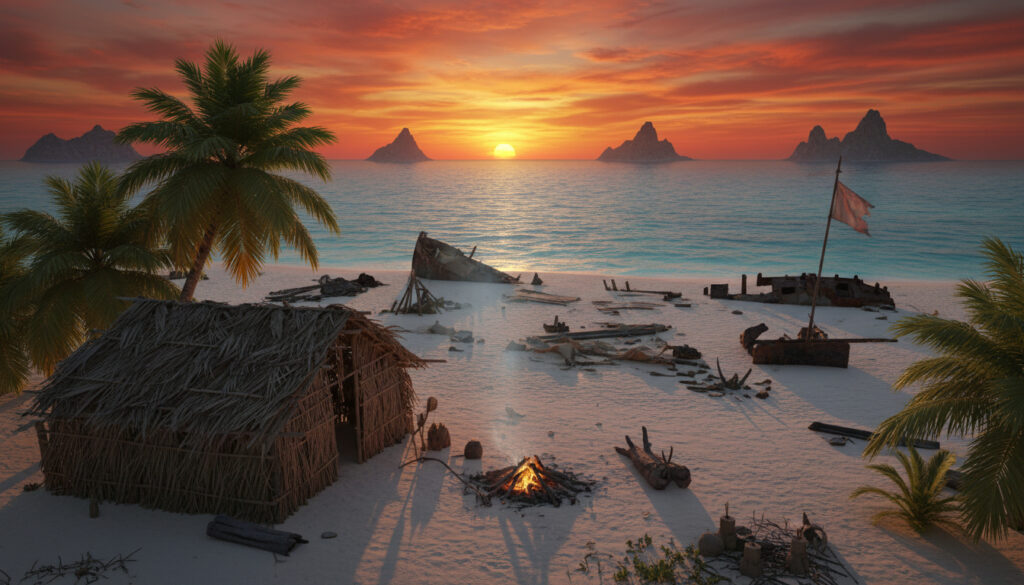
Stranded on Honeymoon Island – Baileys 118-Day Survival
Searches for “stranded on honeymoon island” currently return two distinct narratives that share little beyond the keywords themselves: a BBC reality dating series that maroons matched singles on tropical islands, and the harrowing 1973 Pacific survival ordeal of Maurice and Maralyn Bailey, a British couple who endured 118 days adrift in an inflatable raft. The Baileys were neither newlyweds nor stranded on land, yet their story remains the closest historical match to the query.
The confusion appears to stem from semantic overlap between the reality television format—where participants are literally stranded on islands during simulated honeymoons—and the Bailey’s actual maritime disaster, which involved a married couple, extreme isolation, and a desperate fight for survival. No documented incident exists of recently married couples being stranded on an island specifically named “Honeymoon Island” outside of scripted television.
What Happened to the Couple Stranded on Honeymoon Island?
Incident Classification
Maritime survival (open Pacific Ocean)
Duration of Stranding
118 days (March 4 – June 30, 1973)
Approximate Drift Distance
1,500 nautical miles (2,400 km)
Final Outcome
Rescued by South Korean fishing vessel
Critical Details of the Ordeal
- Vessel Loss: The 31-foot yacht Auralyn sank after a whale strike at dawn on March 4, 1973, while en route to the Galapagos Islands.
- Location: The couple was never stranded on an island, but rather drifted in an inflatable life raft and dinghy in open Pacific waters.
- Missed Rescue Opportunities: Seven ships passed within sight during the drift, but ineffective flares and lack of a signaling mirror prevented detection.
- Physical Deterioration: Both lost approximately 40 pounds (18 kg) and suffered from severe friction sores exacerbated by constant wetness.
- Survival Diet: After initial supplies depleted, they survived on hand-caught turtles, seabirds, and fish hooked with safety pins.
| Fact | Verified Details |
|---|---|
| Couple’s Names | Maurice Bailey and Maralyn Harrison Bailey |
| Marriage Date | December 21, 1963 (England) |
| Departure Point | Southampton, June 1972 |
| Intended Destination | New Zealand (via Panama Canal) |
| Vessel Name/Size | Auralyn, 31 feet (9.4 m) |
| Whale Strike Date | March 4, 1973 |
| Rescue Date | June 30, 1973 |
| Rescue Vessel | South Korean fishing boat Weolmi 306 |
| Post-Rescue Landing | Honolulu, Hawaii |
| Subsequent Memoir | 117 Days Adrift (1974) |
The sinking occurred approximately one year into their trans-Pacific voyage. After the whale strike, the couple salvaged food stores, a compass, and an emergency kit before watching their yacht submerge. They transferred to a 9-foot inflatable life raft and a smaller dinghy, beginning what would become one of the longest recorded survival drifts in Pacific history.
Who Are the Newlyweds and How Long Were They Stranded?
Despite frequent characterization as “newlyweds,” Maurice and Maralyn Bailey were experienced married sailors who had wed nearly a decade prior to the disaster. Maurice Bailey was born January 22, 1933, and Maralyn Harrison was born April 24, 1941. Their 1963 wedding in England predated the 1973 voyage by ten years, during which they had planned and prepared for extended ocean cruising.
The duration of their stranding spanned 118 days, though their published account retained the title 117 Days Adrift to maintain consistency with initial media reports. During this period, the raft gradually disintegrated, requiring constant reinflation and repair while the couple endured storms, shark encounters, and dolphin interactions that occasionally threatened to capsize their precarious vessel.
Daily Survival Mechanisms
Early in the drift, they maintained routines including reading salvaged books and playing cards. As malnutrition advanced, these activities became impossible. Rainwater collection provided hydration, while the psychological toll of spotting seven ships—none of which detected their position—created devastating cycles of hope and despair.
The 1974 memoir 117 Days Adrift contains slight numerical discrepancies with official rescue records. The title reflects initial erroneous reports rather than the actual 118-day duration calculated from the sinking on March 4 to the rescue on June 30.
How Was the Couple Rescued from Honeymoon Island?
Rescue came not through coastal search operations but through the vigilance of the South Korean fishing boat Weolmi 306. On June 30, 1973, crew members spotted the emaciated couple after initially passing by their position. The vessel reversed course to retrieve them from the disintegrating raft, finding both survivors severely weakened but alive.
The Weolmi 306 transported the Baileys to Honolulu, Hawaii, where they received medical treatment for extreme malnutrition, dehydration, and skin lesions. The rescue concluded one of the longest open-water survival periods without auxiliary propulsion or modern emergency beacons.
Post-Rescue Lives
Following their recovery and return to England, the Baileys adopted a vegetarian diet and remained active in sailing communities. They launched a second vessel, Auralyn II, in 1975, continuing their maritime pursuits. Maralyn Bailey died in 2002 at age 61, while Maurice Bailey lived until December 2018, passing away at age 85.
The couple’s survival account, published in 1974, remains a primary source for maritime survival studies. No equivalent documentation exists for the BBC reality series “Stranded on Honeymoon Island,” which depicts contrived scenarios rather than actual survival events.
Is Honeymoon Island Safe and What Lessons Can Be Learned?
No geographic location officially designated “Honeymoon Island” has been associated with the Baileys’ rescue or with any specific recent stranding disaster. Travelers researching remote island honeymoons should distinguish between the BBC reality format—which employs safety crews and emergency protocols—and the genuine risks of isolated maritime travel.
The Bailey ordeal offers concrete lessons for remote travel preparation. Their survival hinged on basic equipment salvage, rainwater collection skills, and rudimentary fishing techniques using improvised hooks. Modern travelers to remote locations can apply these principles through reliable device tracking and redundant communication systems.
The Baileys’ inability to signal passing ships resulted specifically from ineffective flares and lack of a signaling mirror. Contemporary safety regulations mandate multiple visual and electronic signaling devices for vessels crossing Pacific routes.
Remote Travel Risk Mitigation
Individuals planning isolated honeymoons or sailing voyages should consult current maritime safety requirements, including Emergency Position Indicating Radio Beacons (EPIRBs) and satellite communicators unavailable in 1973. While overland travel options present different risk profiles, any remote expedition requires self-sufficiency protocols similar to those employed by the Baileys.
Timeline of the 1973 Pacific Drift
- : Whale strikes Auralyn at dawn; vessel sinks; couple transfers to life raft with salvaged supplies.
- : Initial food supplies consumed; begin rainwater collection; spot first passing ships.
- : Raft material degradation begins; require frequent reinflation.
- : Severe malnutrition sets in; each loses approximately 40 pounds; mobility severely restricted.
- : Visual deterioration of raft structure; increased shark presence.
- : Spotted and rescued by Weolmi 306 crew; transported to Honolulu.
Established Facts vs. Common Misconceptions
Verified Information
- Maurice and Maralyn Bailey married in 1963, not during the voyage
- The incident occurred in 1973, not recent years
- Location was open Pacific, not a specific “Honeymoon Island”
- Rescue by Weolmi 306 on June 30, 1973
- Survival duration of 118 days documented
Persistent Uncertainties
- Specific coordinates of the whale strike remain approximate
- Exact nutritional intake during final weeks unclear
- Whether modern searchers confuse this with other Pacific drifting incidents
- Original Auralyn wreckage never located
Context: Reality Television vs. Historical Fact
The BBC reality format “Stranded on Honeymoon Island” premiered years after the Bailey’s experience, utilizing the romantic isolation trope without the mortal stakes. Participants in the television production receive emergency support, medical standby, and extraction protocols fundamentally different from the 1973 survival situation. The semantic collision between these two distinct categories of “stranded honeymoon” content creates significant search confusion, directing users toward entertainment content when seeking historical survival documentation.
Geographic searches for “Honeymoon Island” typically return results for Florida’s Honeymoon Island State Park or similar recreational destinations, none of which have recorded recent stranding incidents involving married couples requiring rescue services.
Documentation and Primary Sources
“We had seen seven ships and had been passed by all of them. We were down to our last few matches, and the raft was disintegrating around us. When the Weolmi 306 turned back, it was the first moment we allowed ourselves to believe we might survive.”
— Excerpt from 117 Days Adrift (1974), Maurice and Maralyn Bailey
The Baileys’ account remains the sole comprehensive first-person documentation of prolonged Pacific survival during this era. Secondary reporting in maritime journals and encyclopedic entries corroborate dates, distances, and rescue details through Korean shipping logs and Honolulu port records.
Summary: The Reality Behind the Search Term
Investigation confirms that “stranded on honeymoon island” as a search query conflates a 1973 Pacific maritime survival story with contemporary reality television programming. Maurice and Maralyn Bailey survived 118 days adrift following a whale strike, not an island stranding, and were experienced sailors rather than newlyweds. Their rescue by the South Korean vessel Weolmi 306 concluded one of the 20th century’s most remarkable survival ordeals, documented in their 1974 memoir and preserved in maritime history records.
Frequently Asked Questions
Is there a real Honeymoon Island where couples recently got stranded?
No verified recent incidents exist of couples stranded on an island specifically named “Honeymoon Island” outside of reality television productions. The search term typically conflates the BBC show “Stranded on Honeymoon Island” with the 1973 Bailey Pacific drift survival.
Were the Baileys actually on their honeymoon when they were stranded?
No. Maurice and Maralyn Bailey married in 1963, ten years before the 1973 whale strike. They were experienced sailors on a trans-Pacific voyage to New Zealand, not honeymooners.
How did the couple survive without fresh water for 118 days?
They collected rainwater using fabric and containers salvaged from the yacht. They also consumed the blood of turtles and seabirds for moisture and nutrients when rainwater was scarce.
What safety equipment could have prevented this ordeal?
Modern Emergency Position Indicating Radio Beacons (EPIRBs), satellite phones, and effective signaling mirrors would likely have facilitated earlier rescue. Their 1973 equipment lacked these technologies.
What happened to the yacht Auralyn after the whale strike?
The vessel sank within minutes of the collision. The Baileys watched it submerge after salvaging only limited supplies. The wreck was never recovered or located.
Are there other cases of couples stranded at sea for months?
While other maritime survival cases exist, the Baileys’ 118-day drift remains among the longest documented Pacific survival periods for civilians in unpowered vessels. Most modern incidents resolve within days due to improved tracking technology.
More related posts
 Rosy McEwen: Biography, Films, and Background
 RHS Gardens Guide: Prices, Membership, and Which to Visit
 David James: Footballer, Singer, and Their Distinct Stories
 Etihad Airways Guide 2025: Ownership, Fares & Comparison
 Mark Allen: Snooker Career, Debt, Divorce, and New Partner
 Go Ahead Eagles vs Aston Villa – 2-1 Result, Stats and Analysis
 Woody Allen: Controversies, Career, and Actor Reactions
 Mike Graham: What to Know About the Sacked TalkTV Host