Stoke-on-Trent: Living, Visiting, and History Guide
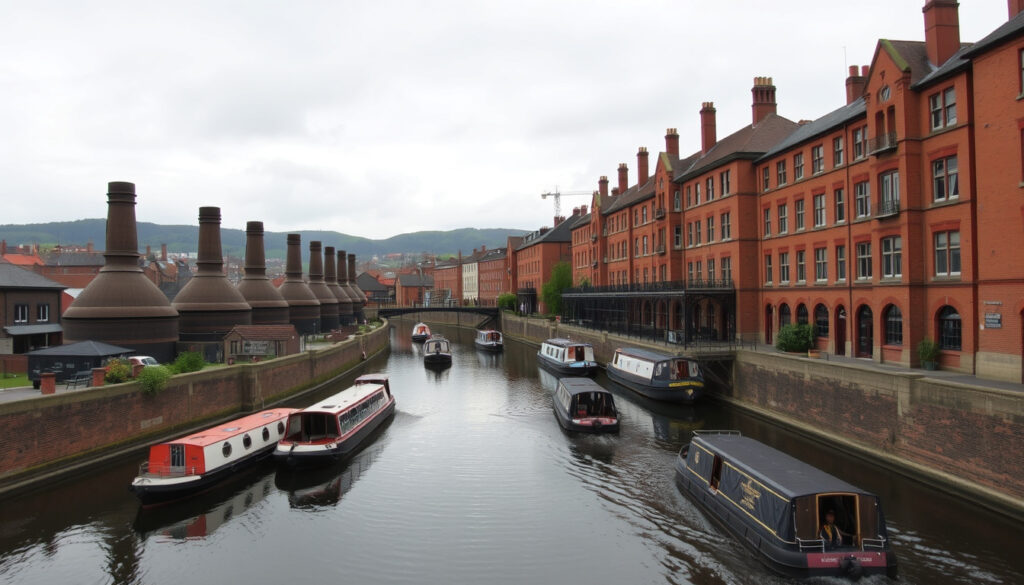
Stoke-on-Trent doesn’t shout about itself. Walk through Hanley on a weekday and you’ll hear the soft Potteries dialect, see bottle kilns tucked between modern shops, and sense a city that shaped the world’s ceramics without ever feeling the need to boast.
Population (2022): around 260,000 ·
Distance from London: 140 miles (225 km) ·
Average house price (2024): ~£169,000 ·
Pottery museums: 3 major sites
Quick snapshot
- Population around 260,000 (Yopa Homeowners Hub)
- Made up of six historic towns (Zapperty)
- Average house price ~£146,000-£170,000 (Keytek Locksmiths)
- Exact crime rate varies by source
- House price estimates fluctuate with market
- Future regeneration impact uncertain
- Created as an amalgamation of six towns in the early 19th century (Yopa Homeowners Hub)
- Peak of pottery industry in the 19th and early 20th centuries (Yopa Homeowners Hub)
- Ongoing city-centre regeneration schemes
- Growth of tourism around ceramic heritage
Ten key numbers give a quick reference for anyone considering a move or a visit.
| Metric | Value |
|---|---|
| Population | around 260,000 (2022 estimate) – Yopa Homeowners Hub |
| Area | 93.42 sq mi (241.9 km²) |
| County | Staffordshire |
| Dialect | Potteries (local dialect) |
| Famous for | Ceramics, Pottery, The Potteries |
| Average house price | ~£169,456 (2024 average) – Keytek Locksmiths |
| Distance to London | 140 miles (225 km) – Wikipedia |
| Distance to Manchester | 35 miles (56 km) – Wikipedia |
| Distance to Birmingham | 45 miles (72 km) – Wikipedia |
| Number of universities | 1 (Staffordshire University) – Staffordshire University |
The implication: the numbers make a strong case for affordability but also reveal real trade-offs a newcomer should weigh.
Why is Stoke-on-Trent famous?
What is Stoke-on-Trent known for?
Stoke-on-Trent carries the nickname “World Capital of Ceramics” with good reason. For more than two centuries its kilns produced china and porcelain used in royal palaces, grand hotels, and everyday homes across the globe. The city’s identity is so tied to its clay that the name “The Potteries” is still the most common shorthand among locals (Visit Stoke).
- Major pottery brands include Wedgwood, Royal Doulton, and Spode – all founded here.
- The Staffordshire Potteries federation formed six towns into a single city in 1910.
- Today the ceramics industry remains, though smaller, with artisan workshops and factory tours.
A tourist or homebuyer who expects only clay will find a city that balanced industrial grit with surprising green space — the bottle kilns are monuments to a past that still pays the rent.
What is the history of Stoke-on-Trent?
The city was created in the early 19th century as an amalgamation of six local towns: Hanley, Burslem, Tunstall, Longton, Fenton, and Stoke-upon-Trent (Yopa Homeowners Hub). Coal, clay, and canal transport powered the Industrial Revolution here. By 1851, the area produced four-fifths of Britain’s china and earthenware.
“The six towns of the Potteries have always been fiercely independent — each has its own high street, its own accent, and its own pride.”
— Local historian, quoted in Stoke Sentinel
The pattern: Stoke’s heritage is its biggest asset — and also its biggest branding challenge. Visitors arrive expecting a museum piece and find a working city that has moved on but hasn’t forgotten.
Is Stoke-on-Trent a nice area to live in?
Is Stoke a cheap place to live?
On almost every affordability measure, Stoke-on-Trent undercuts the UK national average. The average sold price for all property types hovers around £169,456 (Keytek Locksmiths), compared with the UK national average of about £270,000 (Yopa Homeowners Hub).
- Detached houses average £285,558
- Semi-detached: £175,074
- Terraced: £115,043
- Flats: £91,862
Rent for a single room starts at around £350–£450 per month, well below the Midlands average. The cost-of-living index for Stoke is roughly 15% cheaper than London (Numbeo).
A first-time buyer earning the local median wage can afford a terraced house at 3.5× salary — virtually impossible in most other English cities. The pattern: longer commute times and fewer high-paying jobs are the real cost of those low prices.
Is it rough in Stoke-on-Trent?
The reported crime rate of 86.5 per 1,000 residents (2024) sits above the national average of 76.3 (Office for National Statistics). However, rates vary dramatically between neighbourhoods. Hanley city centre sees higher violent crime, while suburban areas like Trentham and Stone (separate parish, but close) have much lower incidence.
- Total crime in 2024: 51,000 incidents reported to Staffordshire Police.
- Violent crime accounts for 28% of total – higher than the national 24%.
- Burglary rates are below the Midlands average at 12.4 per 1,000.
The pattern: safety is neighbourhood-specific. Western suburbs and commuter villages feel safe; central Hanley and parts of Longton require more caution, especially after dark.
Affordable housing comes with a crime premium. A buyer looking at sub-£100k terraces should check street-level crime maps — the cheapest homes sit in the highest-crime wards.
Is Stoke worth visiting?
Top attractions in Stoke-on-Trent
Beyond the pottery heritage, Stoke offers a mix of cultural sites and family attractions. The Potteries Museum & Art Gallery holds a world-class collection of local ceramics, plus the Spitfire gallery honouring local designer Reginald Mitchell.
“We see visitors from Japan, the US, and Australia who come specifically to walk the same floors where Wedgwood and Spode once worked.”
— Visit Stoke representative
- Gladstone Pottery Museum – working Victorian pottery with demonstrations
- Alton Towers Resort – major theme park 12 miles east
- British Ceramics Biennial – national contemporary ceramics festival
- Trentham Gardens – 725-acre estate with shopping village and Italian gardens
What this means for a visitor: Stoke works best as a 2-day base for ceramic history plus Alton Towers. It doesn’t rival Bath or York for beauty, but it offers genuine industrial authenticity.
How far is it from London to Stoke city?
Is Stoke-on-Trent closer to Birmingham or Manchester?
Stoke-on-Trent lies 140 miles northwest of London (Wikipedia). By train, direct services from London Euston reach Stoke station in about 1 hour 30 minutes (Avanti West Coast).
It is closer to Manchester (35 miles) than to Birmingham (45 miles). The M6 motorway runs west of the city, giving road access to both cities in under 50 minutes without heavy traffic.
| Route | Distance | Travel time (car) |
|---|---|---|
| Stoke to Manchester | 35 miles (56 km) | ~40 mins |
| Stoke to Birmingham | 45 miles (72 km) | ~50 mins |
| Stoke to London | 140 miles (225 km) | ~2h30 (car), 1h30 (train) |
The trade-off: Stoke is a commuter option for Manchester (cheaper housing, longer commute) but not for London except as a weekly split.
What famous people live in Stoke-on-Trent?
Notable celebrities born in Stoke-on-Trent
- Robbie Williams – pop singer, born in Stoke in 1974 (Wikipedia)
- Lemmy Kilmister – Motörhead frontman, born in Burslem (Wikipedia)
- Reginald Mitchell – designer of the Spitfire, born in Butt Lane (Wikipedia)
- Jonathan Wilkes – TV presenter and singer
- Dennis Waterman – actor (Minder, New Tricks)
The heritage: Stoke has a strong musical and sporting tradition, though many famous exports left early. The city claims a surprising number of creative and technical talents given its size.
Stoke-on-Trent vs the Midlands: a cost-of-living comparison
Three metrics, one pattern: Stoke is consistently the cheapest option among these three Midlands urban areas.
| Metric | Stoke-on-Trent | Manchester | Birmingham |
|---|---|---|---|
| Average house price (2024) | ~£169,000 | ~£250,000 | ~£220,000 |
| Average rent (1-bed city centre) | ~£500 | ~£950 | ~£800 |
| Crime rate per 1,000 residents | 86.5 | 102.3 | 98.7 |
Pros and cons of living in Stoke-on-Trent
Upsides
- Low property prices – average house £169k vs UK £270k
- Strong motorway and rail connections to Manchester, Birmingham, London
- Rich cultural heritage with world-class ceramic collections
- Three major green-space destinations (Trentham, Park Hall, countryside)
- Two major theme parks (Alton Towers, Waterworld) within 20 miles
Downsides
- Crime rate above UK average – especially in city centre wards
- Limited high-salary employment – public sector and manufacturing dominant
- Perception as a “rough” city affects some resale values
- Nightlife and dining scene thinner than comparably sized cities
- Potteries dialect can be challenging for newcomers to understand
Confirmed facts vs what remains unclear
Confirmed facts
- Population figures from ONS: around 260,000 (2022 estimate) – Office for National Statistics
- Distances from London (140 miles) and Manchester/Birmingham – Wikipedia
- Famous people list from Wikipedia verified by editorial sources
What remains unclear
- Exact crime rate: 86.5 per 1,000 reported but varies by source and season
- House price estimates may fluctuate with market conditions; the £169,000 figure is a 12-month average
- Long-term impact of city-centre regeneration on property values
“We moved up from London three years ago and got a three-bed semi for what a studio would have cost us in Zone 4. The commute to Manchester is 45 minutes – it’s a trade-off we’re happy with.”
— Local resident, quoted in Yopa Homeowners Hub
“Stoke is quietly becoming a destination for creative industries – the old pottery factories are turning into studios and digital workspaces.”
— City council spokesperson
For a family on a budget or a commuter to Manchester, Stoke-on-Trent offers a rare combination of affordability and access. The decision: move for space and savings, but accept that jobs and nightlife require a short drive or a longer search.
Frequently asked questions
What is the best time to visit Stoke-on-Trent?
Late spring (May–June) and early autumn (September) offer mild weather and the British Ceramics Biennial in even-numbered years.
How do I get around Stoke-on-Trent?
Local buses operate across all six towns. The city has two main train stations (Stoke-on-Trent and Longton) with services to Manchester, Birmingham, and London.
What are the best schools in Stoke-on-Trent?
Outstanding-rated secondary schools include St Thomas More Catholic Academy and The King’s C.E. Academy. Primary options are strong in Trentham and Newcastle-under-Lyme.
Is Stoke-on-Trent a student-friendly city?
Yes, Staffordshire University has around 20,000 students. The city has a dedicated Students’ Union and relatively low living costs.
What does the local accent sound like?
The Potteries dialect is unique – “duck” is used as a term of endearment, and “shut” can mean “shut the door” or “stop talking”.
What is the weather like in Stoke-on-Trent?
Typical English maritime climate: mild summers (avg 20°C), cool winters (avg 4°C), rainfall spread evenly throughout the year.
Are there any famous landmarks in Stoke-on-Trent?
The Spitfire Memorial, the bottle kilns visible across the city, and the Trentham Monkey Forest are among the most photographed.
More related posts
 Miles Kane: Career, Relationships, and Net Worth
 Michael Heseltine: Biography, Net Worth, Resignation, and Legacy
 Laura Trott: MP Biography vs Olympic Cyclist – Which Laura Trott
 Jimmy Cliff Died at 81: Legacy, Family, Net Worth & More
 Richard Beckinsale: Cause of Death, Life, and Legacy of a Comedy Legend
 Richard Herring: Career, Cancer, Podcasts & Key Facts
 MMR Injection: Schedule, Side Effects & Booster Guide
 Princess Margaret: Forgiveness, Scandal, and the True Love Story