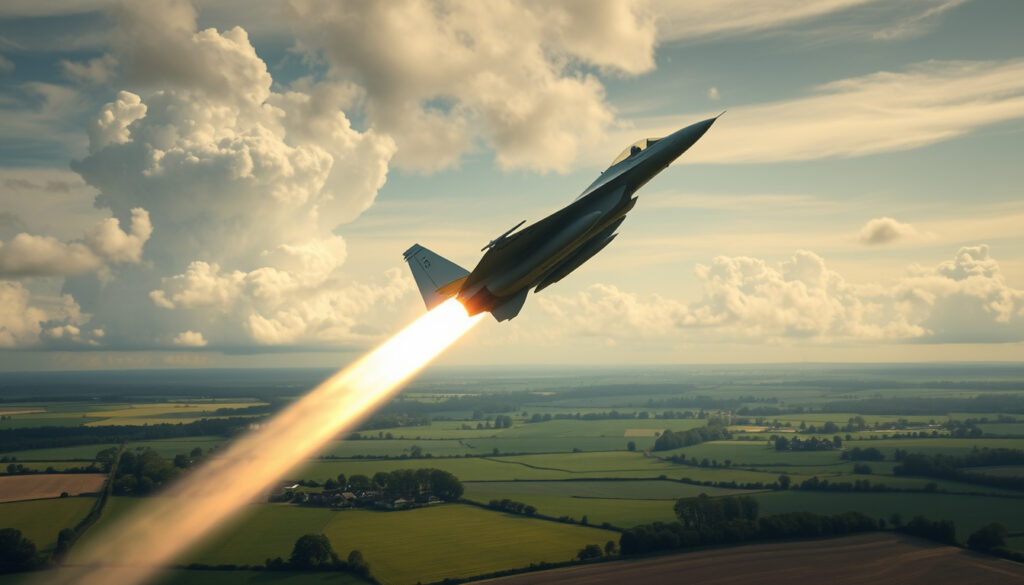
Sonic Boom in Essex – What Caused the Loud Bang
A loud sonic boom shook homes and rattled doors across southern Essex and several neighbouring counties on a Friday morning, prompting a surge of emergency calls from residents convinced an explosion had occurred nearby. The sound, described by witnesses as a deep “vacuum-style” bang, was heard at approximately 11:35am and registered across an area stretching from Chelmsford and Basildon to parts of London, Suffolk, Kent, and Cambridgeshire.
The cause was confirmed swiftly by authorities: two RAF Eurofighter Typhoon jets had scrambled from RAF Coningsby in Lincolnshire under Quick Reaction Alert (QRA) protocols to intercept a San Marino-registered private aircraft — later identified as a Bombardier Global Express — that had lost radio contact with air traffic control over Cambridgeshire. As the jets pushed past the sound barrier during the intercept, they generated the shockwave heard across the region.
Essex Police confirmed there was nothing of concern after the aircraft landed safely at Stansted Airport, where communications were successfully restored before touchdown. The RAF confirmed the Typhoons returned to base without incident.
What Caused the Sonic Boom in Essex?
Sonic boom from supersonic RAF Typhoon jets during a QRA intercept
Approximately 11:35am, Friday
Southern Essex, Cambridgeshire, Suffolk, Kent, and parts of London
QRA scramble — two Typhoons intercepting an unresponsive private jet
- The boom resulted from two RAF Typhoons exceeding the speed of sound during a Quick Reaction Alert scramble.
- The intercepted aircraft was a Bombardier Global Express registered in San Marino, which had lost radio contact over Cambridgeshire.
- RAF Eurofighter Typhoons are capable of speeds up to 1,381mph — nearly twice the speed of sound — and altitudes of up to 55,000ft.
- The sound barrier stands at approximately 750mph; crossing it produces a shockwave that reaches the ground as a thunderous bang.
- No injuries were reported and no structural damage was confirmed following the event.
- The private jet was escorted to Stansted Airport, where communications were restored and it landed safely.
- QRA scrambles are a standard, legally authorized RAF procedure for unresponsive or unidentified aircraft in UK airspace.
| Fact | Details | Source |
|---|---|---|
| Type of event | Sonic boom — not an explosion | RAF / Essex Police (official) |
| Jets involved | Two Eurofighter Typhoons from RAF Coningsby, Lincolnshire | RAF statement / The Independent |
| Intercepted aircraft | Bombardier Global Express, San Marino-registered | Simple Flying / The Independent |
| Trigger for scramble | Loss of radio contact over Cambridgeshire | RAF statement |
| Time of boom | Approximately 11:35am Friday | The Independent / ww2talk.com |
| Aircraft landing location | Stansted Airport — safely, after communications restored | RAF / Essex Police |
| Injuries or damage | None reported | Essex Police / RAF |
| Typhoon maximum speed | Up to 1,381mph (approximately Mach 1.8) | RAF aircraft specifications |
Where and When Was the Sonic Boom Heard in Essex?
The boom registered at approximately 11:35am across a remarkably wide area. Southern Essex was at the centre of reports, with residents in Chelmsford and Basildon among the earliest to describe the event. The noise spread far beyond the county’s borders almost simultaneously.
Which Areas Reported the Loudest Impact?
Confirmed reports came from Cambridgeshire, Suffolk, Kent, and parts of London, in addition to the Essex epicentre. The wide geographic spread reflects the altitude at which the Typhoons were operating — at height, a shockwave fans out across a much larger ground footprint, meaning many communities heard it at the same time despite being miles apart.
Witnesses described the sound as a single, powerful “vacuum-style” bang — distinct from rolling thunder, sudden and immediately followed by silence. The force was sufficient to shake houses and rattle doors and windows across multiple counties.
When a supersonic aircraft flies at altitude, its shockwave reaches a wider surface area before dissipating than it would at low level. This is why residents in Essex, Suffolk, Kent, Cambridgeshire, and London all reported the boom almost simultaneously, even though they were far from each other and from the aircraft’s flight path.
Public Reaction and Emergency Calls
The sudden, unexplained nature of the sound prompted numerous 999 calls. Many residents were convinced an explosion had taken place nearby — a natural reaction to an unannounced, high-intensity sound in a populated area. Essex Police fielded the calls and moved quickly to identify and communicate the cause.
The term reflects the rapid air pressure change that occurs as a shockwave passes through. Unlike a sustained explosion, a sonic boom compresses and then instantly releases atmospheric pressure, producing that characteristic single concussive thud rather than a prolonged blast sound.
Was the Sonic Boom in Essex Dangerous?
Sonic booms produced by fighter jets during QRA operations are startling but not inherently hazardous to people or buildings. The Essex event lasted under a second at the point of ground impact — consistent with the brief pressure impulse generated by a fast-moving aircraft at operational altitude.
Physical Effects Reported on the Ground
The shockwave was strong enough to cause minor structural vibrations, with windows and doors reported rattling across the affected areas. However, no structural damage was confirmed and no injuries were reported in connection with the event. The RAF confirmed a safe resolution with no ongoing public safety concern.
A sonic boom’s peak intensity is greatest directly beneath the aircraft’s flight path. Residents further from that corridor experienced a progressively weaker version of the same shockwave, which explains why some areas reported a sharp bang while others heard only a distant rumble.
Essex Police confirmed this incident required no public action beyond awareness. However, if any loud, unexplained sound is accompanied by visible fire, structural collapse, smoke, or signs of injury in the immediate vicinity, contacting emergency services remains the appropriate course of action. A confirmed sonic boom alone does not warrant a 999 call.
Official Reassurance Following the Event
Both the RAF and Essex Police stated clearly that the situation was resolved without threat to the public. The Bombardier Global Express landed safely at Stansted Airport after communications were re-established, and the Typhoons returned to RAF Coningsby. No further action by residents was required or recommended.
What Is a Sonic Boom and Has This Happened Before in Essex?
A sonic boom is the impulsive noise — similar in quality to a thunderclap — produced when an aircraft exceeds the speed of sound. As the jet accelerates past that threshold, it compresses the air in front of it into a cone-shaped shockwave. When that wave reaches the ground, it produces the sudden, powerful bang heard by residents across Essex and beyond.
Two main sonic boom types are recognized: the N-wave, produced during steady supersonic flight, which has a broader and more even ground footprint; and the U-wave, generated during rapid maneuvers, which covers a smaller area but can produce stronger pressure peaks. The intercept scenario — requiring rapid acceleration — is consistent with the latter type, though the precise flight characteristics of the Typhoons during this specific approach have not been made public.
Previous Sonic Boom Incidents Over Essex
Essex has experienced comparable events before. A near-identical incident occurred in 2013, when RAF jets scrambled in response to a communication failure caused widespread sonic boom reports across Essex. The Ministry of Defence confirmed at the time that the jets had responded to lost radio contact and that everything was fine — an almost exact parallel to the most recent event.
Supersonic flight over populated land in the UK is only authorized for active QRA operations. The Ministry of Defence maintains this authorization specifically to enable rapid response to aircraft that become unresponsive in UK airspace. The RAF currently operates 137 Typhoons across seven squadrons for air defense duties of this kind, supported by Voyager tanker aircraft.
How the Incident Unfolded: A Step-by-Step Account
- Radio contact lost over Cambridgeshire: The San Marino-registered Bombardier Global Express ceased communication with air traffic control while transiting Cambridgeshire airspace.
- QRA scramble initiated: Two Eurofighter Typhoons were launched from RAF Coningsby, Lincolnshire, under standard Quick Reaction Alert protocols in response to the unresponsive aircraft.
- Sound barrier exceeded: The Typhoons accelerated past the speed of sound — approximately 750mph — during the intercept, generating the shockwave that would reach the ground as a sonic boom.
- Boom heard at approximately 11:35am: Residents across southern Essex, Cambridgeshire, Suffolk, Kent, and parts of London simultaneously reported a loud bang shaking their homes.
- Emergency calls placed: Numerous 999 calls were made, with many residents believing an explosion had occurred in their vicinity.
- Aircraft escorted to Stansted Airport: The Typhoons intercepted the Bombardier Global Express and guided it to Stansted Airport, where communications were successfully re-established before landing.
- Safe landing confirmed, jets return to base: The private aircraft landed safely. Essex Police confirmed nothing of concern. The two Typhoons returned to RAF Coningsby.
What Is Established and What Remains Unclear
| Established Information | Information That Remains Unclear |
|---|---|
| Two RAF Typhoons from RAF Coningsby were scrambled under QRA | The precise reason the Bombardier Global Express lost radio contact |
| The intercepted aircraft was a San Marino-registered Bombardier Global Express | Whether the communication failure was due to technical fault or another factor |
| The boom was heard at approximately 11:35am Friday | The exact altitude and flight profile of the Typhoons during the intercept |
| The aircraft landed safely at Stansted; no injuries or damage reported | Whether any formal investigation into the communication failure was initiated |
| QRA is a standard, authorized RAF air defense procedure | Whether any regulatory follow-up action involving the aircraft operator is expected |
The RAF’s Quick Reaction Alert System in Context
The Quick Reaction Alert system is the foundation of the UK’s continuous air defense posture. When an aircraft becomes unresponsive or behaves unexpectedly in UK airspace — as the Bombardier Global Express did over Cambridgeshire — QRA-assigned Typhoons are scrambled within minutes to intercept and assess. The process is practiced constantly and designed to move from alert to intercept rapidly enough to address any threat before it can escalate.
RAF Coningsby in Lincolnshire is one of England’s primary QRA bases, positioned to respond quickly across the Midlands, East Anglia, and the southeast. The Royal Air Force maintains a 24-hour readiness posture year-round, with jets on standby at all times. Supersonic flight over land is normally prohibited in the UK but is specifically authorized during active QRA operations where speed of response is essential.
The Eurofighter Typhoon’s performance specifications — a top speed of 1,381mph and a service ceiling of 55,000ft — make it capable of closing on almost any civilian aircraft in a matter of minutes. That speed capability is precisely what produces the sonic boom when urgency demands it.
What Officials Said: Statements on the Essex Sonic Boom
“The aircraft landed safely at Stansted Airport after communications were re-established. The Typhoon aircraft returned to base.”
— Royal Air Force, as reported by ww2talk.com and The Independent
“Nothing of concern” — Essex Police confirmed the loud sound was a sonic boom produced by military aircraft following the safe landing of the intercepted plane at Stansted Airport.
— Essex Police
Two Typhoon jets escorted a disruptive aircraft to Stansted Airport.
— Stansted Airport statement
Aviation publication Simple Flying, which covers commercial and military aviation in detail, confirmed the aircraft type as a Bombardier Global Express and corroborated the QRA response. In the 2013 incident, the Ministry of Defence similarly stated that jets had responded to lost communication and that the outcome was entirely safe — framing used again in the most recent event.
What the Essex Sonic Boom Tells Us About UK Air Defense
The incident resolved swiftly and without harm to any person or property. It demonstrated both the efficiency of the RAF’s Quick Reaction Alert system and the understandable surprise of a public not accustomed to hearing a supersonic aircraft overhead. Sonic booms over populated land remain uncommon, but when QRA protocols demand rapid intercept, they are a predictable consequence of the physics involved. Residents across Essex, Suffolk, Kent, Cambridgeshire, and London experienced an unusual but ultimately routine feature of the UK’s air defense infrastructure.
For additional context on regional events and community stories from the East of England area, readers may find coverage at Peterborough United F.C. – League One Profile History Facts and Peterborough United F.C. – League One History Key Facts.
Frequently Asked Questions About the Essex Sonic Boom
Was there an official statement on the Essex sonic boom?
Yes. The RAF confirmed two Typhoons intercepted a private jet after it lost radio contact, escorting it to Stansted Airport where it landed safely. Essex Police stated there was “nothing of concern.” Stansted Airport also confirmed that two Typhoons had escorted the aircraft. All official accounts are consistent.
What should residents do after hearing a sonic boom?
When authorities confirm the sound as a military sonic boom, no public action is needed. Essex Police advised residents of this after the event. Emergency services should only be contacted if the sound is accompanied by visible fire, structural damage, smoke, or injury in the immediate area — not for the sonic boom itself.
What is a Quick Reaction Alert (QRA) scramble?
A QRA scramble is an immediate RAF response when an aircraft in UK airspace becomes unresponsive or unidentified. Typhoon jets on constant standby are launched within minutes to intercept and assess the situation. It is a standard air defense procedure and does not indicate a military emergency or hostile threat.
How fast were the Typhoons traveling when the boom occurred?
The jets exceeded the speed of sound — approximately 750mph — during the intercept. The Eurofighter Typhoon has a published maximum speed of 1,381mph, close to twice the speed of sound, and can operate at altitudes up to 55,000ft. The boom is generated the moment that sound threshold is crossed.
Why did so many people call 999 after hearing the boom?
The sound was sudden, loud, and entirely without warning for residents. Witnesses described a powerful “vacuum-style” bang strong enough to shake houses and rattle doors. With no prior public notification, many people reasonably assumed an explosion had taken place, leading to a high volume of emergency calls across Essex and neighbouring counties.
Has Essex heard a sonic boom from RAF jets before?
Yes. A comparable incident occurred in 2013, when RAF jets scrambled in response to a communication failure generated a sonic boom across Essex. The Ministry of Defence confirmed it was a routine QRA response with no threat to the public — the same conclusion reached after this most recent event.
Was the private jet a security threat?
No threat to public safety was established. The Bombardier Global Express lost radio contact — a technical event that triggers a standard precautionary QRA response. Once communications were restored and the aircraft landed at Stansted Airport, both the RAF and Essex Police confirmed the situation posed no concern.
Can a sonic boom cause damage to buildings or hearing?
Sonic booms from fighter jets during QRA operations typically last under a second and are capable of causing minor vibrations — rattling windows and doors — but not structural damage under normal circumstances. No damage or injuries were reported in this incident. Temporary discomfort is possible for those very close to the flight path.
More related posts
 Bershka Jeans Guide: Styles, Prices, and Fit
 Michael Socha: Nationality, Accent, Family, and Career
 Rachel Bilson: Biography, Net Worth, Kids, Co-Parenting
 Random Generator Guide: Numbers, Names, and Wheels
 Zoe Sugg: Net Worth, Relationships, and YouTube Career
 Nancy Wheeler: Key Facts and Relationships from Stranger Things
 Rogers Shaggy: Who Is Norville Rogers? Age & Facts
 Cast of Georgie and Mandy’s First Marriage: Full List & Details