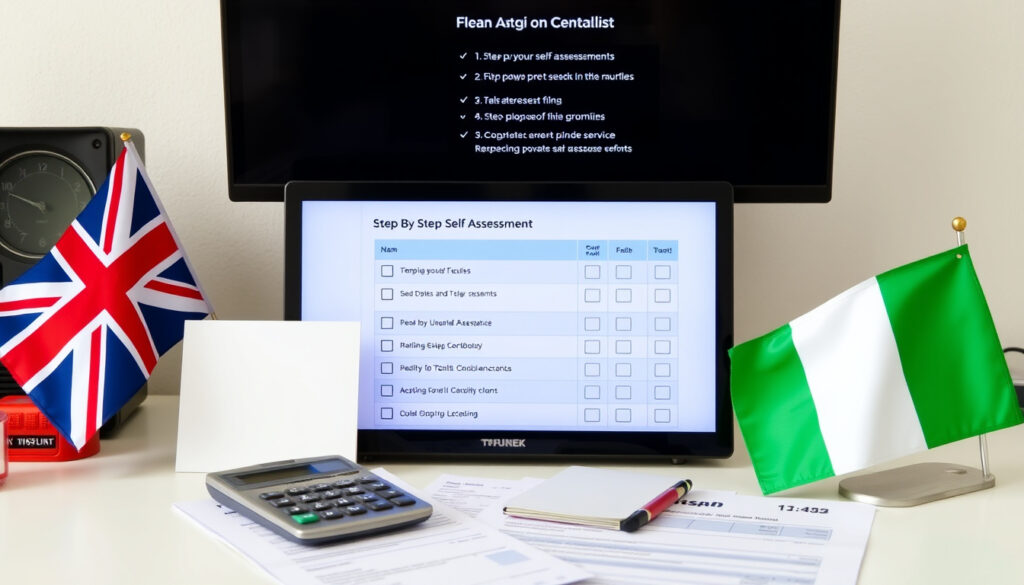
Registering Self Assessment: Step-by-Step Guide for UK & Ireland
Registering for Self Assessment in the UK or Ireland is a mandatory step with strict deadlines, but the rules differ significantly between the two jurisdictions. UK law requires registration by 5 October after the tax year end, while Ireland mandates it if your non-PAYE income exceeds €5,000.
UK Self Assessment registration deadline: 5 October after the tax year end ·
Ireland self-assessment non-PAYE income threshold: Taxable non-PAYE income exceeds €5,000 or gross non-PAYE income exceeds €30,000 ·
Revenue Online Service (ROS) registration: Required for all self-employed in Ireland ·
Average accountant fee for self-assessment return: £200–£500 (UK) / €300–€600 (Ireland)
Quick snapshot
- Personal details and PPSN / National Insurance number (HMRC)
- Income records and business information (Revenue)
- Bank account details for refunds (Revenue)
- UK: 5 October after tax year end (HMRC)
- Ireland: 31 October (paper), mid-November (online) (Revenue)
- Penalties for late registration (Revenue)
Five key facts that summarise the registration landscape:
| Fact | Value |
|---|---|
| UK registration deadline | 5 October after the end of the tax year you need to file for (HMRC) |
| Ireland registration threshold | Taxable non-PAYE income > €5,000 or gross non-PAYE income > €30,000 (Revenue) |
| Typical accountant fee (UK) | £200–£500 for straightforward returns (FreeAgent (accounting software provider)) |
| Typical accountant fee (Ireland) | €300–€600 for straightforward returns (Chartered Accountants Ireland (professional body)) |
| Online registration widely available | Both HMRC and Revenue offer digital registration (HMRC, Revenue) |
How to register with Revenue for the first time?
Step-by-step registration process
- Apply for a Personal Public Service Number (PPSN) if you don’t have one (Revenue)
- Create a Revenue Online Service (ROS) account through ros.ie (Revenue)
- Complete the online registration form with your personal details, income sources, and business type (Revenue)
Online vs paper registration
- Online via ROS is the fastest and most common method (Revenue)
- Paper forms (Form TR1) are available by calling Revenue’s Forms and Leaflets service (Revenue)
- Online registration allows immediate access to MyEnquiries and other digital services (Revenue)
Required information and documents
- PPSN, full name, address, date of birth (Revenue)
- Details of all income sources, including self-employment, rental income, and investment returns (Revenue)
- Bank account number and sort code for refunds (Revenue)
First-time registrants often underestimate the need for a PPSN. Without it, the entire process stalls. Apply for a PPSN at least two weeks before you plan to register.
The implication: starting the ROS registration early gives you a buffer to gather documents and avoid the October bottleneck.
How do I register that I am self-employed?
Distinction between self-employment and employment
- Self-employment means you run your own business and are responsible for your own tax and PRSI (Citizens Advice (UK charity))
- Employment means you work under a contract of service; your employer deducts tax at source (HMRC)
- The distinction matters for registration: self-employed individuals must register for Self Assessment; employees with only PAYE income generally do not (HMRC)
Registration for sole traders vs partnerships
- As a sole trader you register in your own name; as a partnership, one partner registers on behalf of the partnership (HMRC)
- In Ireland, partnerships register through ROS with a separate partnership registration number (Revenue)
- Both structures require a separate tax return for each individual partner (Revenue)
Deadline for notifying HMRC or Revenue
- UK: notify HMRC by 5 October after the end of the tax year in which you started trading (HMRC)
- Ireland: notify Revenue within 30 days of starting self-employment, though the official deadline for filing the return is 31 October (paper) or mid-November (online) (Revenue)
- Late registration can result in penalties; the penalty amount depends on how late you are (Revenue)
A common mistake: waiting until the filing deadline to register. Both HMRC and Revenue require registration well before the return deadline, so delaying registration risks missing the filing window entirely.
The pattern: the earlier you register, the more time you have to organise your records and avoid stress.
Who needs to register with ROS?
Eligibility criteria for ROS registration
- Anyone who is chargeable to Irish tax on non-PAYE income must register for Self Assessment and use ROS (Revenue)
- This includes sole traders, partners in a partnership, company directors, and landlords (Revenue)
- ROS is the mandatory online portal for filing returns and making payments (Revenue)
Income thresholds for mandatory self-assessment
- Taxable non-PAYE income exceeds €5,000 in a year (Revenue)
- Gross non-PAYE income exceeds €30,000 in a year (Revenue)
- If your income is below these thresholds, you may still register voluntarily to claim refunds or pay tax on investment income (Revenue)
Voluntary registration cases
- You can register voluntarily even if your income is below the thresholds, for example to claim a refund of tax deducted at source (Revenue)
- Voluntary registration is also common for individuals who want to pay PRSI contributions to protect their social insurance record (Citizens Information (Irish government service))
- You can cancel your ROS registration if your circumstances change, but you must notify Revenue promptly (Revenue)
The trade-off: voluntary registration opens the door to refunds and PRSI credits, but it also means you must file a return every year, even if your income is zero.
How do I do my first self-assessment?
Gathering income and expense records
- Collect all income statements, including invoices, bank statements, and payment receipts (HMRC)
- Track allowable expenses such as office costs, travel, equipment, and professional fees (HMRC)
- Keep records for at least six years (UK) or six years (Ireland) after the return deadline (HMRC, Revenue)
Navigating the online return system
- UK: use HMRC’s online Self Assessment portal (Government Gateway) (HMRC)
- Ireland: use ROS or myAccount (for less complex returns) (Revenue)
- Both systems provide step-by-step prompts; you can save your progress and return later (HMRC, Revenue)
Common mistakes first-time filers make
- Missing the registration deadline and then filing late (HMRC)
- Forgetting to include all income sources, especially from side hustles or investments (Citizens Advice)
- Claiming expenses that are not wholly and exclusively for business use (HMRC)
First-time filers in Ireland often underestimate the complexity of the Irish tax return, which includes separate sections for rental income, foreign income, and PRSI contributions. A simple error can trigger a Revenue review.
The catch: the first self-assessment is the steepest learning curve. After that, the process becomes routine, but the initial year requires careful attention to detail.
Do I need an accountant for self-assessment?
Benefits of using an accountant
- Accountants ensure your return is accurate and complete, reducing the risk of HMRC or Revenue inquiries (FreeAgent)
- They can identify tax-saving opportunities you might miss, such as claiming capital allowances or reliefs (Chartered Accountants Ireland)
- They handle correspondence with the tax authority, saving you time and stress (HMRC)
When it is safe to file alone
- If your tax affairs are simple – a single source of self-employment income and few expenses – you can likely file yourself (Citizens Advice)
- If you are comfortable using online forms and keeping records, DIY filing can save you the accountant’s fee (HMRC)
- Both HMRC and Revenue provide free guidance and online tools to help first-time filers (HMRC, Revenue)
Typical costs and how to choose an accountant
- UK: £200–£500 for a straightforward return; £500–£1,000+ for more complex cases (FreeAgent)
- Ireland: €300–€600 for a straightforward return; €600–€1,200+ for businesses with rental income or multiple sources (Chartered Accountants Ireland)
- Look for accountants registered with a recognised professional body (e.g., ACCA, ICAEW, Chartered Accountants Ireland) and check reviews or ask for referrals (ACCA)
For a simple return, the cost of an accountant can be justified by the time saved and the peace of mind. But if your income is straightforward and you’re comfortable with the online system, going DIY is a viable option.
Upsides
- Professional accountant reduces error risk and saves time
- Potential tax savings from expert advice
- Peace of mind with HMRC/Revenue correspondence handled
- Online registration is free and quick for straightforward cases
Downsides
- Accountant fees can be £200–£600+ per year
- DIY filing requires careful record-keeping and time investment
- Late registration or filing penalties can be costly
- Complex tax situations (e.g., rental income, foreign income) may require professional help
Timeline
Five key dates that shape the self-assessment calendar in the UK and Ireland:
| Date / Period | Event | Source |
|---|---|---|
| 6 April – 5 April (UK tax year) | Tax year runs April to April; registration deadline is October after year end | HMRC |
| 1 January – 31 December (Ireland tax year) | Irish tax year is calendar year; returns due October/November following | Revenue |
| 5 October after tax year end | UK Self Assessment registration deadline | HMRC |
| 31 October (paper) / mid-November (online) | Irish self-assessment return filing deadlines | Revenue |
| 31 January after tax year end | UK Self Assessment payment deadline | HMRC |
The pattern: the UK and Ireland have different tax years and deadlines, but both require registration months before the filing deadline. Missing the registration window triggers a domino effect of late penalties.
Confirmed facts and what’s unclear
Confirmed facts
- UK registration deadline is 5 October after tax year end (HMRC official)
- Ireland registration required if non-PAYE income exceeds €5,000 (Revenue official)
- ROS is the official online portal for Irish self-assessment (Revenue)
What’s unclear
- Exact accountant fees vary widely by location and complexity (FreeAgent)
- Penalty amounts for late registration depend on individual circumstances (Revenue)
- Whether a specific individual is considered self-employed may require professional advice (HMRC)
Quotes from tax authorities and experts
Anyone with non-PAYE income above the thresholds must register for self-assessment. Failure to do so can result in penalties and interest charges.
— Revenue Commissioners (Irish tax authority), official guidance on registering for self-assessment
You must register for Self Assessment by 5 October after the end of the tax year you need to file a return for. If you do not, you may be charged a penalty.
— HMRC (UK tax authority), Register for Self Assessment
The self-assessment system continues to evolve, and we are seeing more people registering online. It is important to use the correct portal and keep your personal details up to date.
— Chartered Accountants Ireland (professional body for accountants), Self-assessment guide
Summary
Whether you are in the UK or Ireland, registering for Self Assessment is a mandatory step that carries a firm deadline. The UK gives you until 5 October after the tax year end; Ireland requires registration if your non-PAYE income exceeds €5,000. For a first-time filer, the safest route is to register early, keep meticulous records, and consider an accountant if your situation is anything other than a single income stream and a handful of expenses. For the self-employed individual in either country, the choice is clear: register on time, or face the consequences of late penalties and a rushed return.
research.ed.ac.uk, youtube.com, thoughtco.com, thesignhub.eu, cambridge.org, pmc.ncbi.nlm.nih.gov, pmc.ncbi.nlm.nih.gov, assets.cambridge.org, ethereum.stackexchange.com, bengans.nu
For a detailed walkthrough of the process, see this complete step-by-step guide that covers every step from start to finish.
Frequently Asked Questions
What is the Revenue Online Service (ROS)?
ROS is the Irish Revenue’s online portal for filing self-assessment returns, making payments, and managing tax affairs. It is mandatory for self-employed individuals and anyone with non-PAYE income above the thresholds. (Revenue)
Can I register for Self Assessment online?
Yes. In the UK, you register through HMRC’s online Self Assessment service using a Government Gateway account. In Ireland, you register through ROS or Revenue’s myAccount service. Both are free and take about 30 minutes. (HMRC, Revenue)
What documents do I need to register for Self Assessment?
You need your National Insurance number (UK) or PPSN (Ireland), details of your income sources, business type, and bank account information for refunds. (HMRC, Revenue)
What happens if I miss the registration deadline?
You may face penalties. In the UK, a late registration penalty starts at £100. In Ireland, penalties are calculated based on how late you are and can include interest on unpaid tax. (HMRC, Revenue)
Is there any fee to register for Self Assessment?
No. Registering for Self Assessment with HMRC or Revenue is free. There are no application fees or processing charges. (HMRC, Revenue)
How long does it take to complete registration?
Online registration typically takes 20–30 minutes. If you apply by post, allow 2–4 weeks for processing. (HMRC, Revenue)
Can I register if I am not self-employed but have other income?
Yes. You may need to register if you have rental income, investment income, or income from a limited company (e.g., dividends). Check the thresholds for your country. (HMRC, Revenue)
More related posts
 Newcastle Icon Paul Dummett Retires at 34: Career Legacy
 Ruben Loftus-Cheek: height, stats, salary, injury history
 Managing Osteoarthritis: Evidence-Based Relief & Treatments
 Etihad Airways Guide 2025: Ownership, Fares & Comparison
 Robert Kardashian: Biography, Cause of Death, Net Worth, and Legacy
 Alyson Hannigan: Ethnicity, Age, Husband, and Career Facts
 Simon Brodkin: Comedian, Real Name, Stunts, and Net Worth
 Stacey Joe Still Together? Season 3, Age Gap, Weight Loss